


Your Social Media Looks Like A Billboard. That's Why People Keep Driving Past It.
- Digital Natives

- Jul 7
- 14 min read
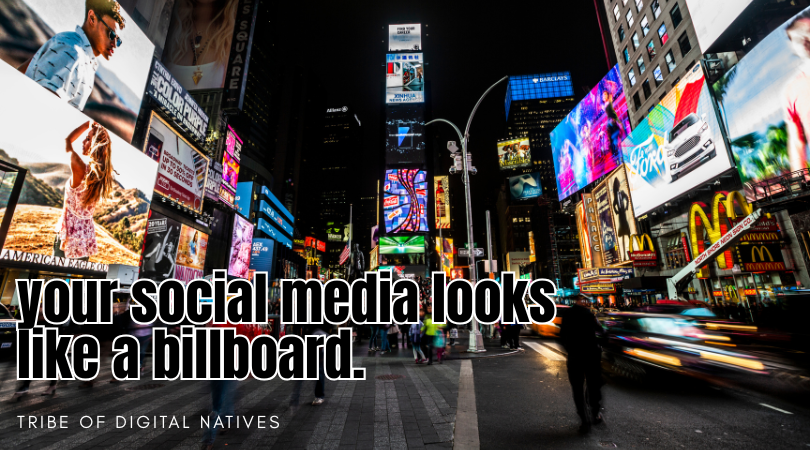
Businesses love to say social media does not work anymore. Then you open their feed and it is one long hostage situation of flyers, announcements, specials, service lists, holiday graphics, stock photos, and “call today” captions dressed up in brand colors.
That is not a social media strategy.
That is a sad bulletin board in a corporate lunchroom with Wi-Fi.
And before anyone gets offended, this does not mean your business should never promote itself. Please promote your business. People need to know what you offer, where you are, how to book, what is available, and why they should take action.
The problem is not that businesses are selling. The problem is that selling has become the entire personality. No context. No useful perspective. No customer education. No actual point of view. No reason for anyone to keep paying attention once they understand, “Yes, you sell the thing.”
A billboard can get away with that because a billboard has one job.
Be seen.
Social media has a much harder job. It has to give people a reason not to scroll past your business like visual spam.
Social Media Is Not A Place To Tape Up Your Latest Announcement
Somewhere along the way, businesses started treating social media like a cheaper version of outdoor advertising.
Post the special.
Post the service.
Post the flyer.
Post the phone number.
Post the same reminder again next week with a different background.
Maybe throw in a holiday graphic, a “now booking” post, and a painfully generic quote for variety.
Technically, yes, that is content. But technically, a vending machine sandwich is lunch. That doesn't mean anyone is excited about it.
Billboard-style social media usually comes from the belief that posting means announcing. The business shows up, says what it offers, tells people to contact them, and leaves. There is no effort to explain why the service matters, what the customer should understand, what problem is being solved, or why this business should be trusted over every other option in the feed.
That's not communication. That's broadcasting. And people are very, very good at ignoring broadcasts.
People don't scroll social media looking for another business announcement. They stop when something feels useful, specific, familiar, irritatingly true, or worth remembering.
A Billboard Only Has To Be Seen. Social Media Has To Be Worth Paying Attention To.
A billboard has a captive audience.
People are driving. → They pass it. → Maybe they notice. → Maybe they remember the name. → Maybe they don't.
Either way, the billboard is not asking for a relationship. It is not asking for comments, clicks, saves, shares, trust, comparison, or decision-making.
Social media is different. People are not trapped in traffic with no choice but to look at your marketing.
They can scroll.
They can mute.
They can unfollow.
They can compare you to someone else in three seconds.
They can decide your business feels useful, annoying, forgettable, thoughtful, pushy, helpful, generic, trustworthy, or completely irrelevant before they ever visit your website.
That is why treating social media like a static ad placement is such a weak strategy. The audience has too much control. And the second your content feels like another digital flyer asking for attention it has not earned, people move on.
The Problem Is Not Promotion. The Problem Is Promotion With Nothing Behind It.
There is nothing wrong with posting a direct offer.
There is nothing wrong with telling people what you sell.
There is nothing wrong with reminding people to book, call, order, schedule, reserve, donate, vote, visit, subscribe, or take the next step.
The issue is when every post asks for action without doing any of the work that makes action more likely. People need more than “call today.”
They need to understand why today matters.
They need to know what problem you solve.
They need to know what they might be overlooking.
They need to know what makes one option different from another.
They need to know what could happen if they choose poorly, wait too long, skip the service, ignore the issue, or assume all businesses in your category are basically the same.
That is where good social media earns its place. It doesn't just say, “Here is what we do.”
It says, “Here is what you need to understand before you decide.”
That is a completely different level of usefulness.
A business can be visible every day and still give people no meaningful reason to choose it. That is the difference between activity and marketing.
Your Feed Should Not Feel Like A Flyer Rack
You know those flyer racks in hotel lobbies, visitor centers, waiting rooms, and corporate lunch rooms?
Everyone has seen them.
Almost nobody is emotionally moved by them.
They are functional. They hold information. They technically serve a purpose. But people usually glance, grab what they already needed, or ignore the entire thing because it all blends together.
That is exactly what happens when a business turns its social media feed into a rotating flyer rack.
One graphic for the service.
One graphic for the special.
One graphic for the hours.
One graphic for the event.
One graphic for the same offer in slightly different words.
It may look organized. It may look branded. It may even look nice. But nice does not automatically mean useful. A polished feed can still be empty. A branded graphic can still say nothing. A beautiful template can still be carrying a dead message across the internet.
And honestly, that may be worse, because now the boring has a font system. Social media should help people understand your business, not just recognize your color palette.
People Do Not Care Just Because You Posted
This is the part that makes people cranky.
Posting is not an achievement by itself.
Yes, your business needs to show up.
Yes, inactive accounts can create doubt.
Yes, a neglected social presence can make people wonder whether the business is still operating, still paying attention, or still worth contacting.
But activity is not the same as impact.
A business can post every day and still teach the audience absolutely nothing.
A business can have beautiful graphics and still give people no reason to care.
A business can repeat its services endlessly and still fail to explain why those services matter.
People are not sitting around waiting for your next announcement. They're fucking busy. Distracted. Skeptical. Overmarketed to within an inch of their lives.
So when your post appears, it has to do more than exist. It has to connect to something the audience already cares about, worries about, wants, needs, questions, or recognizes. That is where social media starts doing actual marketing work.
The feed is not just where people see your business. It is where they quietly decide whether your business understands the problem better than everyone else.
Context Is What Turns A Post Into Marketing
A weak post says:
“We offer this service.”
A better post says:
“Here is when this service matters, why people wait too long, what they usually miss, and how to know when it is time to take the next step.”
That is context.
Context is what helps someone understand why the post applies to them. It turns a flat announcement into something useful. It gives the customer a reason to pause because the content is speaking to the situation behind the service, not just the service itself. This matters for small business social media, service-based marketing, local SEO, brand authority, and customer decision-making because people rarely buy the second they see your first post.
They notice patterns.
They compare language.
They watch how you explain things.
They look for proof that you understand the problem.
They decide whether you sound like someone who actually knows what the hell you are doing.
And if your content never gets past “book now,” you are asking people to trust you without showing them much to trust.
Social Media Should Make Your Business Easier To Choose
The best social media content does not only answer, “What do we sell?” It answers the questions people are already carrying around.
What should I know before I hire someone?
What does this service actually include?
How often do I need this?
What are the warning signs?
What mistakes should I avoid?
Why does this cost what it costs?
How do I know if this business is qualified?
What happens if I wait?
What makes this approach different?
What does this business notice that other businesses ignore?
Those questions are marketing gold.
They support SEO because they match the way people search.
They support AEO, or answer engine optimization, because they provide direct answers to real customer questions.
They support GEO, or generative engine optimization, because they help AI-powered search tools understand what your business does, who you serve, what you know, and why your content is relevant.
And more importantly, they support actual humans trying to make actual decisions. Because despite what the internet keeps trying to turn marketing into, people still need to feel like they understand enough to choose.
Most businesses are not under-posting. They are under-thinking what the post is supposed to accomplish.
Your Social Media Should Show How Your Business Thinks
Your services matter, obviously. But your thinking is what separates you.
The way you explain a problem tells people whether you understand it.
The way you talk about your industry tells people whether you have standards.
The way you answer common questions tells people whether you are paying attention.
The way you address hesitation tells people whether you know what customers are actually worried about.
The way you educate tells people whether your business is useful before money ever changes hands.
That is the part billboard-style content misses.
A billboard can show your name, offer, and phone number.
Social media can show your judgment.
Your process.
Your standards.
Your experience.
Your refusal to participate in the same generic nonsense everyone else is posting.
That is where your business becomes more recognizable for reasons that actually matter.
Not because the logo appeared seven times this month. But because people are starting to understand the way your business sees the problem.
Stop Blaming The Algorithm For Content That Says Nothing
Yes, algorithms are annoying.
Reach changes.
Platforms shift.
Engagement gets weird.
Social media can feel like trying to have a conversation in a casino during a fire drill. But not every weak result is the algorithm’s fault.
Sometimes the post was boring.
Sometimes it said nothing new.
Sometimes it was a flyer pretending to be content.
Sometimes the caption was just a sales pitch wearing pants.
Sometimes the business posted an offer to people who had not been given enough context to understand why the offer mattered.
Sometimes the graphic looked professional, but the message was dead on arrival.
That does not mean the business is doomed. It means the strategy needs to grow the hell up.
Stop asking every post to close the sale before the audience has been educated, reassured, challenged, informed, or given a reason to trust you.
That is not how people decide.
The goal is not to make every post louder. The goal is to make the business harder to confuse with everyone else.
The Fix Is Not Just “Post Better Content”
This is where generic marketing advice usually slides in with a cute little list of content ideas.
Post tips.
Post FAQs.
Post behind the scenes.
Post testimonials.
Post educational content.
Post your team.
Post your process.
Fine. Sure. None of that is wrong. But that's not the real fix. A business can follow that entire list and still sound like every other business in its category.
The fix is not simply posting different types of content. The fix is knowing what your content is supposed to prove.
Are you showing people that you understand the problem better than your competitors?
Are you making the decision easier?
Are you challenging the weak advice people keep hearing?
Are you explaining what actually matters before someone spends money?
Are you making your business more recognizable for something stronger than a logo and a color palette?
That is the work.
Not filling a calendar.
Not dressing up another announcement as “value.”
Not posting a tip because some marketing guru said tips perform well on Tuesdays.
Your social media should have a reason for existing beyond keeping the account warm. If the post does not help people understand, trust, remember, compare, question, decide, or take the next step, then what the hell is it doing?
This Is Bigger Than Social Media
The real issue is not one bad post. It is actually a bigger marketing habit.
Businesses keep confusing presence with purpose. They believe that because something was posted, something was accomplished. They check the box, fill the calendar, publish the graphic, and move on.
But content without direction is just noise with a logo on it.
Your social media should connect to the rest of your marketing. It should support your website, blog content, service pages, search strategy, customer education, lead generation, reputation, and brand recognition.
That doesn't mean every caption needs to be an essay. It DOES mean every post should have a job beyond taking up space.
Some posts can educate.
Some can promote.
Some can send traffic to your website.
Some can answer a question.
Some can support a larger campaign.
Some can show proof.
Some can make people feel seen.
Some can position your business against bad advice, weak standards, or common industry mistakes.
But if the only job is “post because we need to post,” do not be shocked when the audience responds with the same level of enthusiasm.
None.
If the whole feed sounds like “book now,” “call today,” and “we offer this,” the business has not built a presence. It has built a rotating ad slot.
Social Media Is Where People Start Deciding What Kind Of Business You Are
People may not contact you the first time they see your post.
They may not like it.
They may not comment.
They may not share it.
They may not do anything publicly at all.
But they may read it. And...
They may remember it.
They may click later.
They may send it to someone privately.
They may visit your website next week.
They may compare you to a competitor and realize your business explained the problem better.
They may decide, quietly, that you are the one they trust.
That is why social media cannot be treated like a throwaway announcement space.
It is part of the buying process now.
It is part of the research process.
It is part of how people evaluate whether your business knows what it is doing.
A billboard can tell people you exist. Your social media should help people understand why the hell they should choose you.
The Tribe of Digital Natives POV
At Tribe of Digital Natives, this is exactly the kind of marketing behavior we call out because it is everywhere.
Generic advice tells businesses to “just show up,” “post more,” “stay visible,” and “keep feeding the algorithm” as if publishing more content automatically means the content is doing something useful.
We don't buy that shit.
Posting more billboard-style content does not make your marketing stronger. It just gives people more of the same thing to ignore.
We are strategists, not template pushers. If something smells like marketing bullshit, we are going to call it out. Not because we enjoy being difficult — although, let’s be honest, sometimes we absolutely do — but because businesses are tired of wasting time, money, and energy on advice that sounds good in a webinar and falls apart the second it meets real customers.
We are not here to help businesses blend into the same recycled content loop everyone else is stuck in. We help businesses think harder about what they are saying, why they are saying it, who needs to hear it, and what the hell the content is supposed to do once it is out in the world.
We are going to challenge the generic playbook.
We are going to question the “best practices” that stopped being useful three platform updates ago.
We are going to push back when a feed looks polished but says absolutely nothing.
Why? Because marketing should not exist just to prove your business is active. It should help people understand why your business is worth choosing.
And if your current strategy is just a rotating stack of digital flyers with a logo slapped on top?
We are probably going to say that out loud.
Questions Businesses Should Ask Before Posting Another Digital Flyer
Why should businesses stop treating social media like a billboard?
Businesses should stop treating social media like a billboard because social platforms are not passive advertising spaces. People are not forced to look. They can scroll, ignore, compare, mute, unfollow, or research another option immediately. Social media needs to do more than announce services. It should educate, build trust, answer questions, support customer decisions, and make the business easier to choose.
What does billboard-style social media look like?
Billboard-style social media usually looks like a feed full of one-way announcements, service graphics, specials, flyers, holiday posts, “call today” captions, and repeated promotions with very little context. These posts may be accurate, but they often fail to explain why the service matters, who it helps, what problem it solves, or why the business is different from other options.
Is promotional content bad for business social media?
Promotional content is not bad. Businesses should absolutely post offers, services, updates, events, availability, and direct calls to action. The problem is when promotional content becomes the entire social media strategy. Strong business social media balances promotion with education, proof, customer questions, useful context, and a clear point of view.
Why do people ignore business posts on social media?
People often ignore business posts because the content does not feel relevant, useful, specific, or worth their attention. If a post only says “book now” or “call today” without explaining why someone should care, the audience has no real reason to pause. People are more likely to pay attention when content connects to a problem, question, concern, goal, or decision they already have.
What should small businesses post on social media?
Small businesses should post content that helps people understand their services, process, expertise, standards, and customer experience. Strong post ideas include FAQs, educational tips, common mistakes, myths, service explanations, behind-the-scenes details, customer proof, local or industry-specific advice, and posts that explain when, why, or how someone should take the next step.
How does social media help people choose a business?
Social media helps people choose a business by showing how the business thinks, communicates, solves problems, and understands its customers. Before contacting a business, people often look for signs of trust, expertise, relevance, and professionalism. Useful social content can reduce hesitation and make the decision easier.
Does social media help SEO?
Social media does not replace SEO, but it can support a stronger digital presence. Social posts can send people to website pages, reinforce important topics, promote blog content, support brand searches, and help customers discover answers before they search more deeply. When social media content connects to website content, service pages, and helpful resources, it becomes part of a bigger search strategy.
What is AEO and how does it apply to social media?
AEO stands for answer engine optimization. It focuses on answering the questions people ask in search engines, voice search, AI tools, and other answer-based platforms. Social media supports AEO when posts directly answer customer questions, explain common decisions, and provide useful information in natural language.
What is GEO and why does it matter for business content?
GEO stands for generative engine optimization. It refers to helping AI-powered search tools understand your business, expertise, services, audience, and relevance. Specific, useful, well-connected content across your website and public platforms can help generative tools better understand what your business does and when it may be relevant to a search or question.
How can I tell if my social media strategy is too promotional?
Your social media strategy may be too promotional if most posts are built around selling, booking, calling, ordering, or announcing without much education or context. If your feed feels like a flyer rack, your audience may be seeing what you offer without understanding why it matters. A stronger strategy gives people reasons to trust, remember, and choose your business before asking them to take action.
What is the difference between posting and having a social media strategy?
Posting means publishing content. A social media strategy means knowing why the content exists, who it is for, what job it is doing, and how it supports the larger business. Posting fills a calendar. Strategy supports decisions, website traffic, customer education, brand recognition, trust, and sales opportunities.
How often should a business post promotional content?
There is no perfect number for every business, but promotional content should not be the only thing your audience sees. A business can post direct offers regularly as long as the feed also includes education, proof, customer-focused information, and content that helps people understand the value behind the offer. The goal is not to hide the sale. The goal is to make the sale make sense.
About Tribe of Digital Natives
Tribe of Digital Natives is a strategy-first digital marketing collective built for businesses that are done confusing motion with direction. We do not chase trends, manufacture noise, or treat visibility like a substitute for operational clarity. Our work focuses on the systems underneath the marketing: positioning, messaging, SEO, brand consistency, audience trust, and long-term strategic alignment.
Based in South Florida and working nationwide since 2010, Tribe of Digital Natives helps businesses build marketing strong enough to hold attention and structured enough to hold trust.
Never cookie-cutter.
Never beige.
Never bullshit.
Bold enough to make noise. Wise enough to make it matter.
Subscribe to The Signal
Long-form thinking from Tribe of Digital Natives on marketing, positioning, visibility, and the long game.
No trend-chasing.
No recycled LinkedIn fluff.
No performative “growth hacks.”
Just strategic perspective built to outlast the algorithm cycle.



Comments